Feb 20, 2026
By Hisham Alrashdan Founder of InfoGleam | 20+ Years in Healthcare & Dental Systems Engineering
I love healthcare integration work—but I’ve learned the hard way that interoperability only “works” when it’s predictable, safe, and auditable.
In clinical environments, the challenge isn’t just parsing a message; it’s building a workflow that clinicians and stakeholders can trust. This requires strong validation at the boundaries, minimal surprise behavior, and a clean separation between “what came in,” “what we decided,” and “what we produced.”
That is the philosophy behind my latest repository:
- Website: infogleam.com
- Project Repo: github.com/Hisham-InfoGleam/openclaw-clinical-interop-poc
The Vision: Interoperability That’s Secure by Default
Most clinical interoperability pipelines eventually boil down to a few repeating steps:
- Intake: A message arrives via HL7 v2, webhook, or gateway event.
- Validate: Confirming the data is authentic, well-formed, and expected.
- Interpret & Transform: Extracting meaning and mapping it into a standard model like FHIR.
- Route: Delivering results to downstream systems, alerts, or review channels.
- Trace: Keeping correlation IDs to prove exactly what happened.
Where most projects fail is not in the transformation (step 3); they fail in trust and auditability (steps 2 and 5). This POC is designed to be “portfolio-grade,” grounded in real consulting needs that can be extended into production later.
Why OpenClaw for Clinical Interop?
“Agentic” AI tooling can go wrong quickly if it’s not constrained. In healthcare, you cannot afford vague behavior. This project treats OpenClaw as an integration model that encourages:
- Small, Composable Skills: Instead of one huge “AI brain,” we use deterministic, testable modules for parsing and mapping.
- Strict Input Validation: Every external boundary is “Zod-first,” rejecting malformed data before it enters the system.
- Clear Orchestration: Tools do the work, orchestration routes the data, and logging ties it all together.
System Architecture: The Secure Pipeline
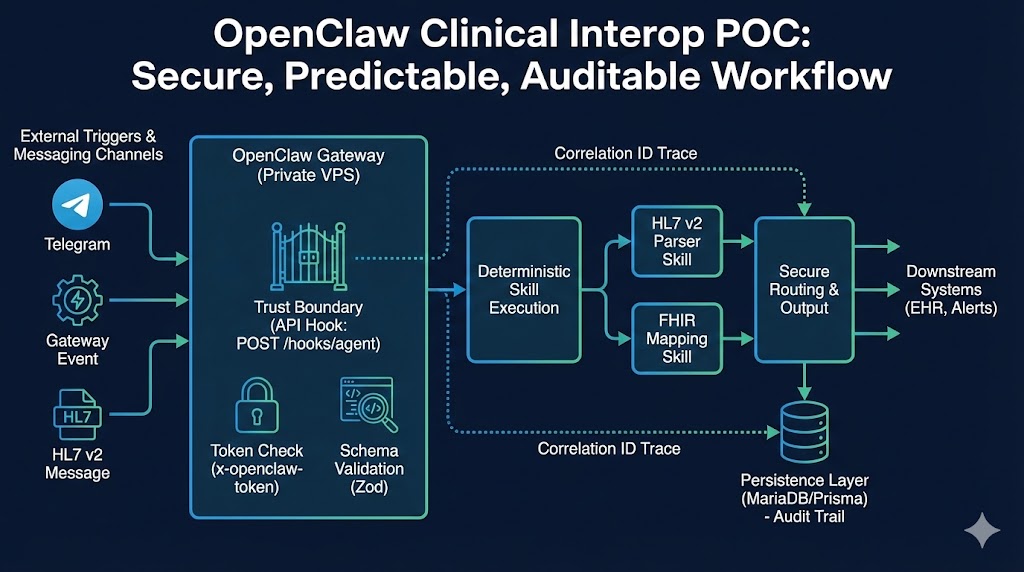
The repository documents a secure Hook → Skill → Output pipeline:
- Messaging Channels: Telegram or other external triggers.
- OpenClaw Gateway: A self-hosted, private VPS that acts as the primary runtime.
- Automation API (
POST /hooks/agent): The “Trust Boundary” where validation occurs. - Skill Execution: Deterministic HL7 parsing and FHIR mapping.
- Persistence: An optional but planned MariaDB/Prisma layer for audit trails.
Technical Deep Dive: The Trust Anchors
1. Safe Webhook Intake
The API endpoint uses a shared token check (x-openclaw-token) and full schema validation. If the payload doesn’t match the expected shape, it is rejected immediately.
2. Deterministic Parsing and Mapping
Clinical data needs determinism, not “creative” AI interpretation. My skills for HL7 v2 and FHIR mapping are designed with strict input/output schemas and no hidden side effects.
3. Correlation IDs for Traceability
Correlation IDs are the unsung heroes of integration. This project leans into this pattern early, allowing you to connect intake logs, skill execution, and final mapping outputs into a single, traceable thread.
Roadmap: What’s Next
While the project has solid “bones,” I am currently working toward these technical milestones:
- Hook-to-Skill Dispatch: Turning the intake route into an active orchestrator.
- Execution Audit Persistence: Storing every run with sanitized inputs and status timings.
- Expanded Integration Tests: Covering failure paths and fallback behaviors.
Why This Matters
Healthcare integration isn’t glamorous—it’s messy and unforgiving. But when you build it right, you unlock massive leverage: less manual work, fewer errors, and faster operations.
Interoperability should feel safe. Not magical. Not fragile. Safe.
[View the OpenClaw Clinical Interop POC on GitHub]
About the Author
Hisham Alrashdan is an expert in healthcare and dental software systems with over 20 years of experience. Through InfoGleam, he focuses on building secure, efficient, and human-centric automation tools that bridge the gap between complex data and actionable insights.


Leave a Reply